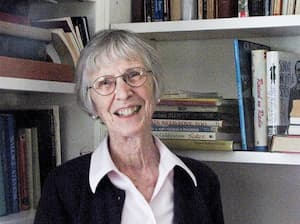
Barbara Jean Beeching, published author/historian,
mother of 6, completed doctorate at age 82.
My friend Aga sent me this quote from Saul Bellow, who, it seems to me, got it right,
“Losing a parent is something like driving through a plate-glass window. You didn’t know it was there until it shattered, and then for years to come you’re picking up the pieces—down to the last glassy splinter.”
My mom died last month and I’m starting to pick through the shards of glass.
I wasn’t planning on putting this news out there but it seems I’m not very good at grief. Left unattended, it leaks out sideways, expressed as anger or frustration or numbness. So I thought maybe it’s better to get this out directly to you all.
Besides, my mom was a regular reader of these Monday Bytes. She only commented on the ones she liked, so if/when I hear from her, I’ll let you all know.
In the last visits I had with her, while she was in hospice care, she was mainly sleeping—and I didn’t want to disturb her as she was clearly navigating the distance between the two worlds.
But if I had read a poem to her then, this would have been it. So mom, this one’s for you.
About the poem: Eavan Boland was a celebrated Irish poet and a professor at Stanford. “In my generation,” Boland said, “women went from being the objects of the Irish poem to being the authors of the Irish poem.”
This one is centered on the river Liffey that runs through Dublin. It’s the river that James Joyce in Finnegans Wake embodied as a woman-river and mother. That’s one view of a timeless myth about the river of life as feminine. Here Boland has reimagined Anna Liffey, bringing her here and now for us all.
If you’d like to listen to it, this is me reading it for my mom.
Yeah, it’s a little long (7 minutes), but my mom was 94 when she died, and now, it seems, time itself has become more fluid. There’s time for a poem, and this one’s got everything you want.
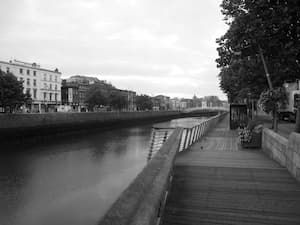
The River Liffey.
Anna Liffey
by Eavan Boland
Life, the story goes,
Was the daughter of Canaan,
And came to the plain of Kildare.
She loved the flat-lands and the ditches
And the unreachable horizon.
She asked that it be named for her.
The river took its name from the land.
The land took its name from a woman.
A woman in the doorway of a house.
A river in the city of her birth.
There, in the hills above my house,
The river Liffey rises, is a source.
It rises in rush and ling heather and
Black peat and bracken and strengthens
To claim the city it narrated.
Swans. Steep falls. Small towns.
The smudged air and bridges of Dublin.
Dusk is coming.
Rain is moving east from the hills.
If I could see myself
I would see
A woman in a doorway
Wearing the colours that go with red hair.
Although my hair is no longer red.
I praise
The gifts of the river.
Its shiftless and glittering
Re-telling of a city,
Its clarity as it flows,
In the company of runt flowers and herons,
Around a bend at Islandbridge
And under thirteen bridges to the sea.
Its patience at twilight —
Swans nesting by it,
Neon wincing into it.
Maker of
Places, remembrances,
Narrate such fragments for me:
One body. One spirit.
One place. One name.
The city where I was born.
The river that runs through it.
The nation which eludes me.
Fractions of a life
It has taken me a lifetime
To claim.
I came here in a cold winter.
I had no children. No country.
I did not know the name for my own life.
My country took hold of me.
My children were born.
I walked out in a summer dusk
To call them in.
One name. Then the other one.
The beautiful vowels sounding out home.
Make of a nation what you will
Make of the past
What you can —
There is now
A woman in a doorway.
It has taken me
All my strength to do this.
Becoming a figure in a poem.
Usurping a name and a theme.
A river is not a woman.
Although the names it finds,
The history it makes
And suffers —
The Viking blades beside it,
The muskets of the Redcoats,
The flames of the Four Courts
Blazing into it
Are a sign.
Any more than
A woman is a river,
Although the course it takes,
Through swans courting and distraught willows,
Its patience
Which is also its powerlessness,
From Callary to Islandbridge,
And from source to mouth,
Is another one.
And in my late forties
Past believing
Love will heal
What language fails to know
And needs to say —
What the body means —
I take this sign
And I make this mark:
A woman in the doorway of her house.
A river in the city of her birth.
The truth of a suffered life.
The mouth of it.
The seabirds come in from the coast
The city wisdom is they bring rain.
I watch them from my doorway.
I see them as arguments of origin —
Leaving a harsh force on the horizon
Only to find it
Slanting and falling elsewhere.
Which water —
The one they leave or the one they pronounce –
Remembers the other?
I am sure
The body of an ageing woman
Is a memory
And to find a language for it
Is as hard
As weeping and requiring
These birds to cry out as if they could
Recognize their element
Remembered and diminished in
A single tear.
An ageing woman
Finds no shelter in language.
She finds instead
Single words she once loved
Such as ‘summer’ and ‘yellow’
And ‘sexual’ and ‘ready’
Have suddenly become dwellings
For someone else —
Rooms and a roof under which someone else
Is welcome, not her. Tell me,
Anna Liffey,
Spirit of water,
Spirit of place,
How is it on this
Rainy Autumn night
As the Irish sea takes
The names you made, the names
You bestowed, and gives you back
Only wordlessness?
Autumn rain is
Scattering and dripping
From car-ports
And clipped hedges.
The gutters are full.
When I came here
I had neither
Children nor country.
The trees were arms.
The hills were dreams.
I was free
To imagine a spirit
In the blues and greens,
The hills and fogs
Of a small city.
My children were born.
My country took hold of me.
A vision in a brick house.
Is it only love
That makes a place?
I feel it change.
My children are
Growing up, getting older.
My country holds on
To its own pain.
I turn off
The harsh yellow
Porch light and
Stand in the hall.
Where is home now?
Follow the rain
Out to the Dublin hills.
Let it become the river.
Let the spirit of place be
A lost soul again.
In the end
It will not matter
That I was a woman. I am sure of it.
The body is a source. Nothing more.
There is a time for it. There is a certainty
About the way it seeks its own dissolution.
Consider rivers.
They are always en route to
Their own nothingness. From the first moment
They are going home. And so
When language cannot do it for us,
Cannot make us know love will not diminish us,
There are these phrases
Of the ocean
To console us.
Particular and unafraid of their completion.
In the end
Everything that burdened and distinguished me
Will be lost in this:
I was a voice.
Missing you,