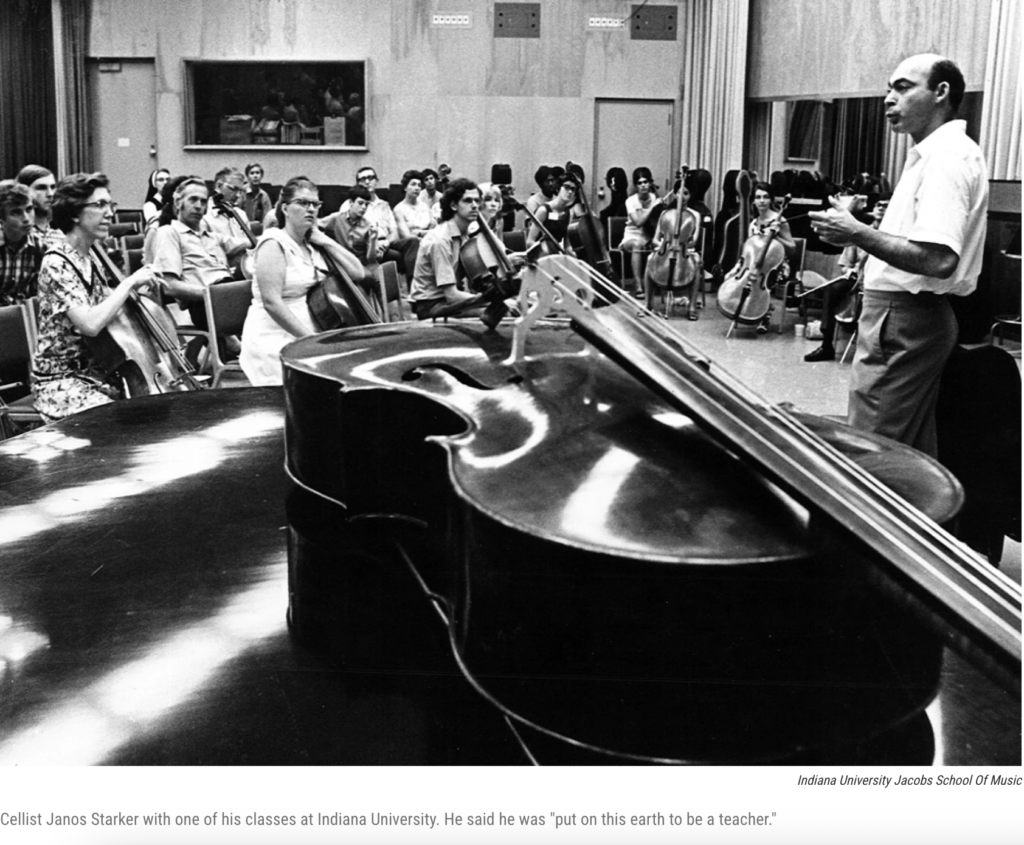
Giving advice to folks who are preparing for college level music teaching jobs often includes tips on how to teach the demonstration lesson or public master class. I’ve found this is a “mystery” area for many musicians, because although they’ve been on the receiving end of many master classes and may have some good teaching experience, many have never taught a public master class.
In a job interview context, a master class involves working with a student you don’t know (whose teacher or coach may be in the room) with limited time per student, often just 20 minutes. In that time, we’re expected to develop a rapport with the student and our audience and to diagnose key performance issues and showcase “teaching interventions” that make a demonstrable impact. Education is a two way street: it’s a dance. The search committee is looking to see a feedback loop between you and the student: each party learning from and reacting to each other.
To help, here are 5 tips:
1. Rapport:
Make sure you address the student by name, smile, and shake her / his hand at the start.
2. Assess:
listen and watch a whole aria/movement if possible—but if time is short, listen to a chunk equivalent to the exposition before interrupting. While observing, note what’s working well as well as what could be improved. Of the latter, you’ll need to diagnose and select just a few “big ticket” issues you want to focus on.
3. Respond 1st with the positive:
tell the student specifically what you appreciated in their performance: what you see as their strengths. Be detailed, genuine, and appreciative: don’t phone this in.
4. Make Strategic Interventions.
Of the issues you might address, select those that will have demonstrable impact—that will unlock multiple improvements in the performance. These could be something technical and/or conceptual that the student can apply to not just to the passage in question, but eventually to the thinking in an entire piece, and their music making in general. Even with a specific technical intervention that might be “small” in scope, you might offer a new way of thinking or listening that has a much larger ramifications.
The “trick” lies in selecting what to focus on and on how to address the issue so that it helps free up a number of aspects in the performance. In a master class situation, this calls for a mix of intuition, teaching experience, and “people reading” skills. Work on items one at a time. Ask the student to experiment by making a clear specific change.
Give the student a chance to see how the change feels and then ask do they hear the difference. And ask your audience if they hear a difference.
5. Be real:
you’re dealing not just with the mechanics of music-making, you’re dealing with students’ emotions, ambitions, and self-esteem. Remember that in the end, your subject area is not simply music, it’s life.
Bonus: In case you haven’t seen it, watch this fabulous Barbara Cook master class from The New York Public Library.
Question for the week: What master class experiences do you have to share—good or otherwise—either as student, teacher, or audience member? What were the lessons learned? Who’s your master class hero and why?
Here’s to more inspired teaching,
PS: For my most in-depth help applying for college teaching jobs, with step-by-step instructions and examples to upgrade all your application materials, see my Land the Job program, HERE.