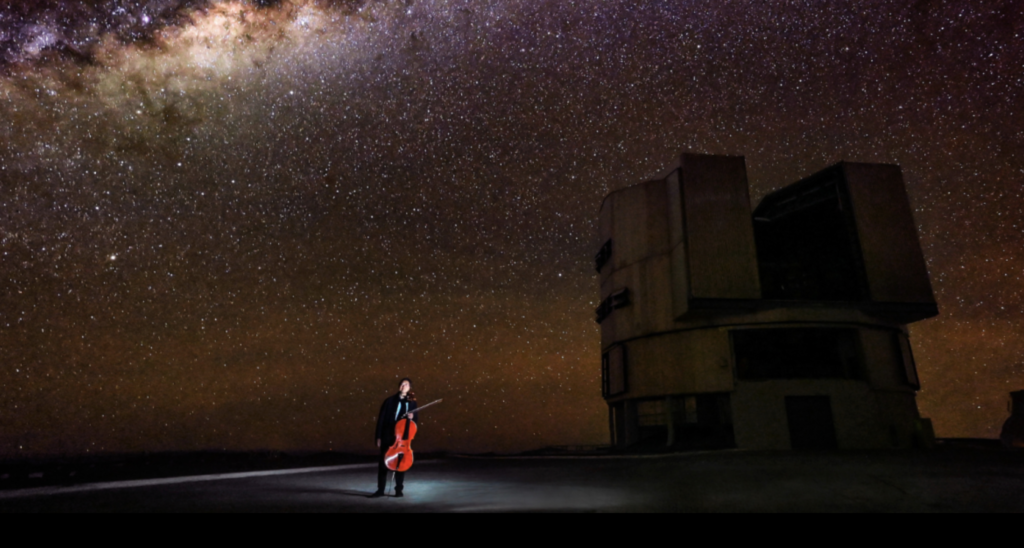
On Nov. 21, I attended a marvelous event here in Boston. Yes, it was a concert—but it felt more like an inspired community gathering, an experiment in belonging and collective dreaming.
I’m still thinking about it. I’m still feeling into it. I’m still asking myself: What IS a concert, anyway?
On paper, it seemed straightforward: Yo-Yo Ma giving a Celebrity Series performance at Symphony Hall, playing all six Bach suites. These solo suites are pillars of the cello repertoire—and all six in one sitting is a marathon for performer and audience alike. As a recovering cellist who loves Bach and Yo-Yo, I still had to gut check: Am I ready to hear all six again?
But here’s the thing: this wasn’t simply a concert.
The event was titled We the People: Celebrating Our Shared Humanity. One thousand Symphony Hall tickets were given to first responders, librarians, and youth groups. Beyond Symphony Hall, the performance was livecast to more than 16 communities across the state—at museums, community centers, libraries—where people could attend this event together (no streaming it alone at home). The whole point was to experience community.
At the Boston Public Library’s Copley Square branch (where I experienced this), the line to get in wrapped around the building. The livecast was free but ticketed—and completely sold out.
In many ways, this event reflected who Ma is as an artist and a human being. Known for his inventive cross-genre collaborations—and for constantly reinventing his career through initiatives like The Silk Road Project, his Bach Project, and Our Common Nature, Yo-Yo Ma focuses on bringing communities together through music to explore culture’s role in society. His work centers connection, imagination, and our shared humanity.
We the People’s pre-game for meaning-making
At the library before the concert livecast began, audience members watched short video clips of grassroots nonprofit leaders in our state—people working at the front lines of community change—asking Yo-Yo Ma the questions that mattered to them. His responses were thoughtful, generous, openhearted.
Topics ranged from:
• the role of culture in leading change
• the connection between math and music
• how he handles performance anxiety
• how communities can heal
Framing the suites
Then, at 8 pm, Ma walked onstage and explained that the evening was his birthday gift to himself (he’d recently turned 70). It was also a homecoming (he’s a resident of Massachusetts) and the culmination of his touring Bach Project.
Begun in 2018, the project brought the Bach suites and Ma across six continents to partner with local communities in events that explored how culture connects us. His definition of “culture” is wonderfully broad: arts, literature, food, science—everything that helps us understand one another.
On Nov. 21, before playing each of the first five suites, Ma offered brief, engaging introductions to them. He told us that the suites were Bach’s investigation of what’s possible on the instrument. He shared that Wynton Marsalis once told him that the prelude of the third suite felt like an improvisation—and that this is exactly what the preludes are: Bach’s written improvisations. And the remaining movements? All dances.
Ma also characterized the emotional territory of each suite—what each invites us to feel. For example, he described the fifth suite as music for those who’ve experienced loss, especially a loss of dignity.
Though he played each suite without pauses between movements, he reassured us we couldn’t get lost: the last movement of every suite is a jig. To make it unmistakable, he mouthed “JIG” before playing each suite’s finale.
The performance itself
For context: Ma has recorded the Bach suites three times in his career. But the version I would most want to own is the one he would record now. At 70, having lived with these suites for 65 years, and having performed them around the globe, he brings them to life with an immediacy, depth, and a sense of play that is astonishingly new.
An interactive concert
As audience members entered the hall, we were handed small note cards and pencils.
After the first suite, preparing us for the more reflective second, Ma spoke about his four grandchildren, and how he thinks about the future, the world they will inherit. He held up his card and asked us to write a specific wish for our community 25 years from today.
We wrote. Then he asked us to exchange cards with someone we didn’t know. (He traded his with a young boy in the front row.)
This simple exercise created a palpable sense of connection—hope moving through the room. The cards were printed on seed paper, and Ma reminded us we were responsible for shepherding our partner’s wish into the future, planting it where it can grow.
As Elisa Birdseye noted in her concert review for The Boston Musical Intelligencer, Ma said that “music has the power to connect and heal, but most of all, music is an engine for imagination, and for any change to happen, we must imagine it first.”
Encore
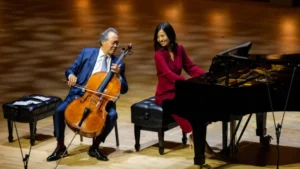
Birdseye also described the final magic of the evening—a surprising encore. During Ma’s standing ovation, a piano was wheeled onto the stage. Then Boston Mayor Michelle Wu came out to join Ma in performing the Bach/Gounod Ave Maria. Birdseye wrote, “How much better the world could be if all mayors could do the same.”
Thank you, Yo-Yo Ma, for reminding us that we hold our grandchildren’s shared futures.
Watch the encore here (click the image to get a clear vide)
And if you’re curious about how coaching can help you align your projects with your values to build a more fulfilling life in music, let’s talk.
Dream Big, Plan Smart, Live Well