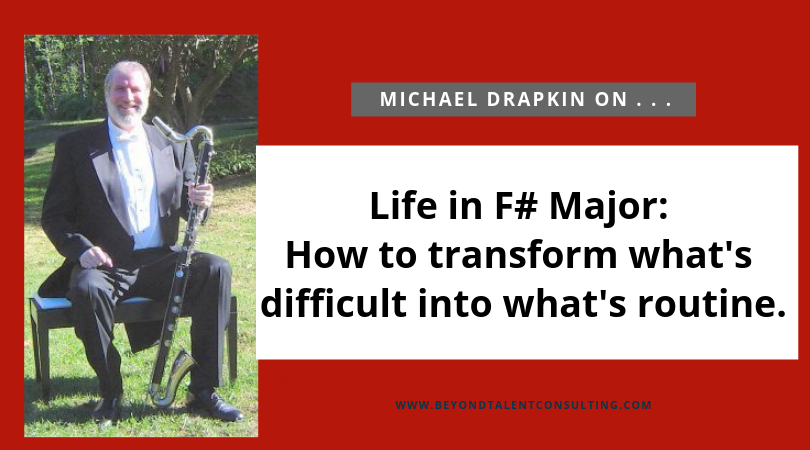
My friend and colleague, clarinetist and entrepreneur Michael Drapkin sent me a thought-provoking email titled Life in F# Major. On how musicians can transform what’s difficult into what’s routine. With his permission, here’s what he writes . . .
“I’m working on my latest book – ‘Drapkin’s Book of Clarinet Calisthenics,’ which is a daily exercise book that tells you exactly what to play to build your technique. There are 15, 30 and 60 minute versions, and I still use them today.
The exercises go through all of the keys – major and minor, and it got me thinking about playing in ensembles where people complain about the difficulty of playing in ‘hard’ keys. Often my response is, ‘but it is just a B major scale!’
If you make the ‘hard’ keys a part of your daily constitutional, then they are no longer so hard, and you’ve built the neural pathways to recognize them when they come up.
Isn’t that sort of a metaphor for life? Make the tough stuff a part of your routine, so that when they come up in life, you will recognize them and know what to do.”
Metaphors R Us
Thanks, Michael: I love the metaphor. It’s a little like the Boy Scout motto of always being prepared, or Hamlet’s “The readiness is all.” If we prepare fully and work on the basics regularly, then what was once difficult becomes easier. We build our own capacity.
That’s great for the situations where we know what’s needed for preparation. But how do we prepare to handle unforeseen career challenges and setbacks? I wondered how to apply Life in F# major in these situations.
All creative acts involve risk and unexpected difficulties. Challenges and setbacks are parts of life. Especially if we’re daring to take on new projects or ventures.
Because there’s no guarantee that the project we take on will be successful. Or that our new venture will play out as expected.
But we CAN apply the metaphor of Living Life in F# major here. The difficult part isn’t key signature, it’s how we respond to challenges and disappointments.
Setbacks anyone?
Think about the last career-related setback you experienced. Maybe it was a ‘disaster’ audition or interview, a bad review, or a fundraising campaign that didn’t reach its goal.
Of course you were disappointed and discouraged, maybe even resentful and angry.
But think back and calculate how long you sustained that negative state of mind. Did this setback change your sense of who you are going forward?
All too often I’ve seen musicians let setbacks amplify their own internal narrative of not being ‘good enough.’
In other words, they let their self-worth ride on external validation.
Some people are crushed and sidelined for weeks or months. They stay stuck hoping and waiting for an external positive occurrence to change their circumstances and their state of mind.
Worse, after a career setback, some musicians default into “playing it safe” and avoid risks and new challenges—they settle for the status quo.
How to avoid this trap?
LA-based authors Phil Stutz and Barry Michels (the “most sought-after shrinks in Hollywood”) teach a set of Tools for handling the challenges of creative work.
The tool they recommend for setbacks is “the Turnaround.” It’s the ability to change your own inner state. To turn the negative self-judgment and despair back towards the positive: to acceptance and hopefulness. “To transmute pain into power.”
It’s what successful entrepreneurs, leaders, and creative artists do. They acknowledge their disappointment and remind themselves that they’ve been knocked down before. That they’ve gotten back up and on track, into forward motion.
Successful creatives remind themselves that they’ve undergone “hero’s journeys” before. That they’ve faced fears, risks, and failures both big and small. And that these are challenges are necessary for change and growth to happen.
The art of the “turn around”
Resilient musicians choose to get back in the ring. They use a growth mindset to complete a “turnaround.”
Turnarounds involve not being derailed by disappointments. Instead, accepting that these will happen periodically, but choosing to move ahead regardless.
Stutz and Michels recommend that instead of defining success by the number of career “wins” we’ve had, that instead we count the number of Turnarounds we’ve accomplished. They define true confidence as having the knowledge that you can recover, refocus, and keep on going. (For more help, check out the Tools books, articles, and podcasts.)
If you rack up enough Turnarounds—changing your own state of mind and rebounding—then coping with setbacks won’t be so hard. You’ll have built the neural pathways to deal with disappointments. Michael Drapkin’s metaphor of Living Life in F# major applies to practicing technical calisthenics to build musical capacities, as well as practicing “Turnarounds” so we can move ahead and achieve our goals.
Want to sample expert music career coaching? Join our next hot-seat coaching session! Get on the e-list here, so you get the notification, plus the weekly newsletter of music career tips and inspiration.

Dream Big, Plan Smart, Live Well