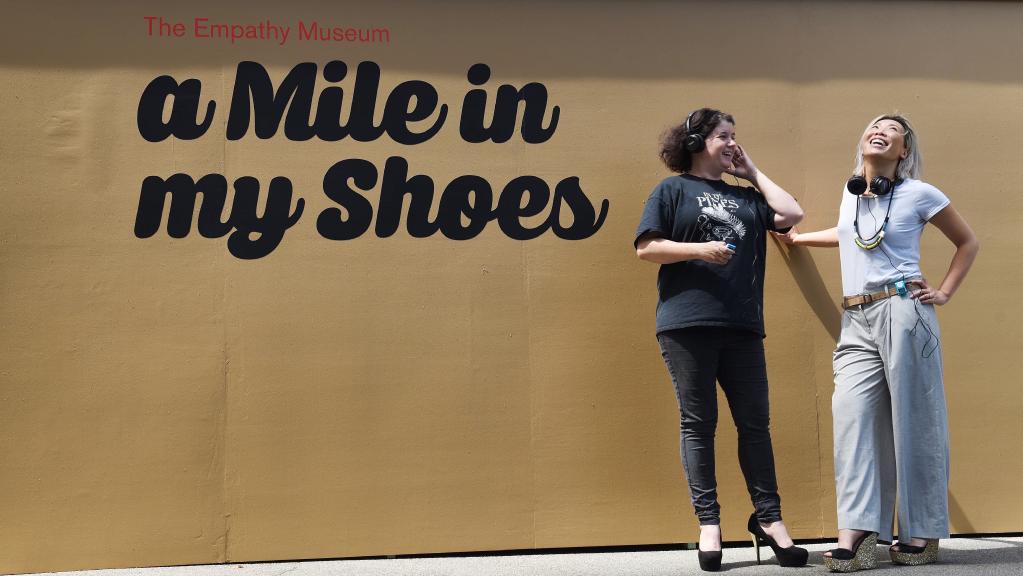
(NOT me and Florrie)
My BFF walking partner Florrie brought up this terrific question the other day, Florrie thinks it’s something you either have or you don’t. What do you think, Can you teach empathy? The essential skill for musicians.
I’m not so sure.
There are of course people who seem to be more naturally empathic. Or maybe they’re just more demonstrably considerate and kind. It turns out empathy is often confused with pity, sympathy, and compassion, which are each reactions to the plight of others.
I’m partial to this definition from the Empathy Library. “Empathy is the imaginative act of stepping into the shoes of another person and viewing the world from their perspective.” This means really trying to understand that person’s feelings, beliefs, hopes and experiences. Her or his view of the world.
At any rate, Florrie’s marvelous question sent me on a wonderful wild goose chase reading about empathy. I was dipping into Brené Brown, Seth Godin, and Carl Jung.
As musicians we actually need to be using empathy all the time. It’s needed to communicate well with colleagues, audiences, and students. And then there’s also negotiating contracts, booking calls with presenters, and all of our marketing efforts. Much of our success depends on our ability to see the other person’s perspective. From playing chamber music to producing our promo materials, we need to frame out messages appropriately so that we can connect and collaborate.
In fact empathy is baked in to arts experiences. Mary Lou Aleskie, who directs the Hopkins Center for the Arts at Dartmouth, has described the role of arts and culture as “gateways for civic engagement, for learning, and for empathy building.” So as musicians, we’re essentially promoters of empathy: a noble pursuit.
Music as a fast track to empathy.
Think about what happens between a performer and her audience. It’s a human exchange: emotional, social, and spiritual. This is what the musicologist Christopher Small has described as “musicking.” A kind of collaborative act of meaning-making and community-building.
Live performances provide — for both musicians and audience — the opportunity to feel something together, to become a temporary community within the performance space, reminding each person that she or he is not alone. That’s empathy and community-building in action.
How does this work? One of the amazing things about music is that it bypasses our thought process and our language functions, and acts directly on our nervous system, the way a narcotic does.
Researchers have found that regularly engaging in group music activities conspicuously advances children’s empathy development. Musical activities increase a child’s capacity to recognize and consider the feelings of others. And listening to music is widely known to release brain chemical and hormones that produce feelings of pleasure, contentment and bonding, and lowering stress.
Why have humans evolved to respond to music this way? It makes sense if we consider the biological imperative. In order to survive, humans need to be able to work and live together in communities. This requires empathy.
Developing our empathic skills
I realize now that my own empathy has been honed over the years through a range of somewhat unlikely activities. These weren’t aimed at empathy at all. But nonetheless, they helped me further develop whatever empathic skills I might have had to start.
I’ve worked on empathy skills “by accident” in marketing courses, negotiation and fundraising workshops, through playing and teaching chamber music, and through my own career coaching practice.
And then there’s reading. A chance to try out what it’s like to crawl inside someone else’s life.
Some of the best help I ever found for working in higher education was the book, “The College Administrator’s Survival Guide.” Written by C. K. Gunsalus, the book is a first hand tour of real life challenges that a college deans or provosts face (with names changed to protect privacy). It’s fantastic for helping faculty and staff understand what the jobs and worlds of deans and conservatory presidents are actually like. It helped me see my work in a much more balanced context.
The verdict: Can you teach empathy? The essential skill for musicians
These were all ways for me to increase my empathy skills and to keep me developing them! For people like me—introverts and anyone else who ever feels socially awkward—we need to believe that empathy is a muscle we can strengthen.
The thing is, we have to remember to use that muscle.
Because in day to day activities, all too often we take our views, our perspectives, our own skewed sense of reality as Truth. And we can find ourselves shocked at how a neighbor or stand partner views the same circumstances quite differently. It’s easy to open mouth, insert foot.
What we take as truth, as reality, is only OUR truth, OUR reality.
In order to understand anyone else we need to take a leap in our imagination. To set aside our own views and try to see what they see, feel what they feel, and at least understand what they believe. This makes space for connection and community. And of better music making!
Here’s the best thing I found this week: the amazing Empathy Museum. I love it! Here’s the opportunity to literally walk in the other person’s shoes: check it out—
As always, I appreciate hearing from you—and I’d LOVE to hear about the creative project you’re working on!
If you’d like to have a conversation about your goals and career plans, and how coaching might help you get past whatever’s been holding you back, let’s schedule a time to talk! Reach me at Angela@BeyondTalentConsulting.com.
Let’s do it!

Dream Big, Plan Smart, Live Well