Teaching Artist Skills for Musicians: these are the essentials we all need. If the term “teaching artist” is new to you, it means more than an a working musician who also teaches. It’s someone who creates arts experiences that help audiences make their own meaning—who designs concerts and events to actively engage audiences in meaning making.
Teaching Artists integrate their art form, perspectives, and skills in a wide range of settings beyond the traditional concert hall. Teaching artists bring their magic to schools, hospitals, shelters, prisons, community centers, and social service agencies.
The Teaching Artist Continuum
There’s a wide range of ways that teaching artist skills show up. At the most basic level, there’s introducing a work from the stage or doing pre- or post concert Q&A to engage audiences. Speaking to audiences in a way that truly engages their imagination and welcomes them into the music—that’s a core skill needed for this work.
At the other end of the spectrum might be an in-depth residency where you work with youngsters on creating an original opera. And maybe the kids not only write the libretto and score with you, but they also design and paint the scenery, cast the parts, create the costumes, and promote and perform the show.
In exploring examples of stellar teaching artist work, I was looking for the essential connecting thread along the continuum. What is it at the heart of all this work?
For me, the key is helping the audience make personally relevant connections to the music we present. In other words . . .
Teaching Artists help audiences succeed in making their own meaning in and through the music they perform.
So it’s a co-creative process. The audience isn’t passive. They are actively working to connect and create meaning for themselves.
This is a fundamental human need. Psychiatrist and holocaust survivor Viktor Frankl, in his 1946 book Man’s Search for Meaning wrote that the primary motivation of a person is to discover meaning in life. What we do as musicians is offer a platform for doing some of that essential work.
What’s in a name?
The terms we have for this work of helping listeners make their own meaning are problematic. “Outreach” is a loaded term that can connote a one-way delivery system for an elitist art form. And as for “teaching artist,” musicians often get hung up on the idea of teaching. We may equate it with delivering information, vocabulary terms, and factoids about the composer or the instruments.
The truth is, whether you’re introducing a work from the stage, in a classroom, or at a senior center, if your focus is on information delivery, you’re most likely turning off your audience. For most listeners, delivering facts about a work only reinforces the idea that our music is elitist. That it’s for ‘insiders’ who know all the vocab and when to clap.
Focusing on teaching about the music gets in the way of helping audiences make meaningful connections with the music. The audience needs to be invited in to the experience through how you introduce the work. You are the facilitator.
What’s your preference? Maybe you like your music . . .
Straight, no chaser: music without words
In recent weeks I heard two performances in which none of the musicians spoke. The performances themselves were excellent but for me, these were lost opportunities.
These were a loss for the performers because it meant that people who didn’t know these artists already were less likely to go back stage afterwards to speak with them. This is human nature: “stranger anxiety” in action. We haven’t heard how someone expresses herself in words. We don’t know how “down to earth” she might be, or how snooty, so we’re uncomfortable risking going backstage to talk — for fear it might be an awkward exchange. If you don’t think this matters, then maybe you don’t care to connect with your audience, make new friends, or cultivate fans and potential donors. Think about it.
And it was also a loss for the audience members who might have loved getting a little extra clue to help in listening to a new work or a complex composition. I’m not just talking about people new to the art form. I’m a veteran concert goer and I would have loved to have heard about the more unusual works on each program.
Here’s an example from the . . .
Danish String Quartet
A few years ago I heard the Danish String Quartet play an amazing concert in Boston in which their violist Asbjørn Nørgaard spent a few moments introducing one of the works, Schnittke’s third quartet, which was new to me. In his remarks, Nørgaard referred to the quartet’s attraction to Schnittke and his dark side. Nørgaard spoke about the composer’s personal struggles and of using his music as a way to work through the question of the existence of God.
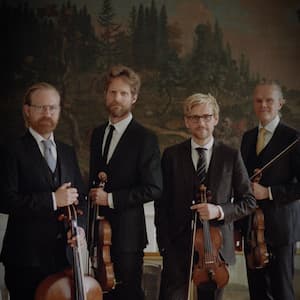
The piece quotes the Beethoven Grosse Fugue, which was also on the program, and quotes Orlando de Lassus’ Stabat Mater. The quartet demonstrated both of the quoted themes to help us clue in on what to listen for. And Nørgaard commented that we might, in listening to the piece, find our own solace, whether in religion or in its absence. He invited us to experience the work, to find our meaning, in our own way. He also lightened up the mood by offering a beer for the audience member who managed to count all the quoted excerpts in the piece.
What was the effect?
Nørgaard spoke candidly and without pretense about himself and his colleagues, the composer’s issues, and the big questions the work alludes to. As he spoke, you could actually feel the energy in the hall change. You could feel the audience warming up with a sense of our common shared humanity. It got us open and curious to hear the work and to make our own discoveries in it.
I couldn’t find this on video for you, but here are two clips I did find to help in connecting with audiences:
Check out the Takács Quartet’s Approach to Introducing a Work
The first is from the Takács Quartet Workshop: an introduction to Beethoven’s Op. 59 nr. 3—check out what the first violinist Ed Dusinberre chooses to tell us.
This example was done for the quartet’s online workshop so it’s longer than the intro you’d use in a live performance. But it should give you ideas for how to engage audiences with real life issues and emotions—and questions—that a work can evoke, helping get us interested in experiencing the piece. Ed also works in his own personal connection with the last movement. Does this intro get your ears itching to hear the whole piece?
And next here’s the pianist James Rhodes introducing a Chopin Prelude using a letter from the composer to his Dad at a “Letters Live” event. James’ short introduction and performance (5:35 total) is candid, genuine, irreverent, and much appreciated by his audience.
Pianist James Rhodes connecting with an audience, Making Meaning
Challenge: think about the best introduction from the stage you’ve ever experienced as an audience member. What made it great?
Find more help on doing effective Teaching Artist work, check out . . .
I hate public speaking
and
The problem of what to say
and
How well are you connecting with your audience?
If you want to sample expert music career coaching, join our next hot-seat coaching session! Get on the e-list here, so you get the notification, plus the weekly newsletter of music career tips and inspiration.
Here’s to more meaning making: Teaching Artists R Us,
Dream Big, Plan Smart, Live Well!